
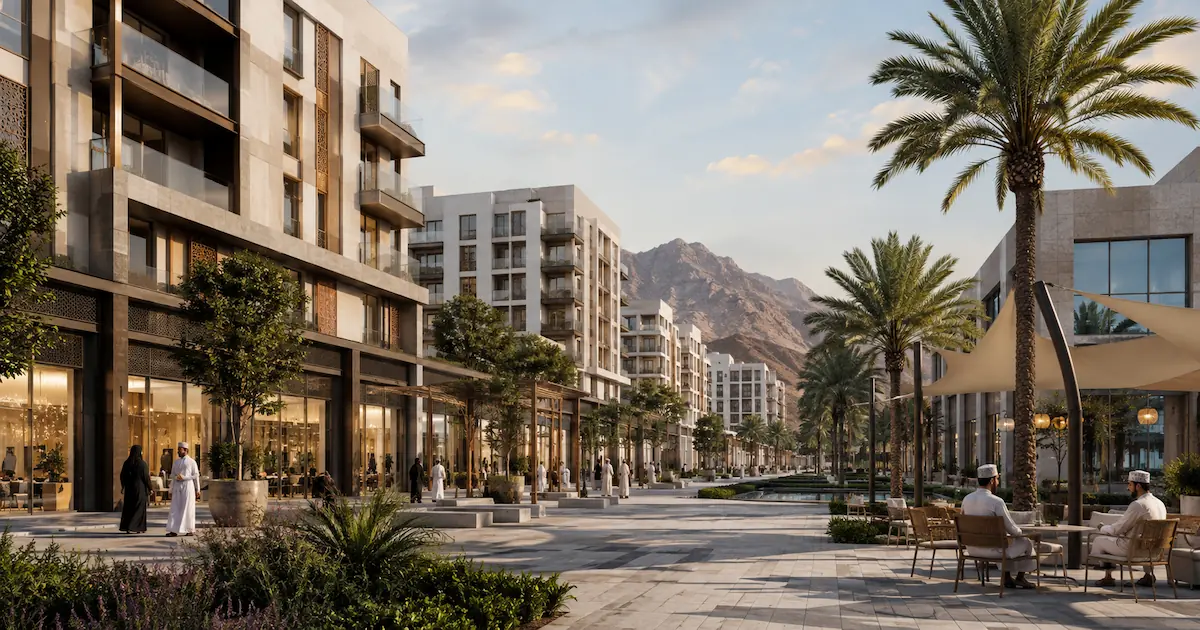
Construction Investment in Oman
Mixed-use development in Oman is becoming an important strategy for investors who want to create projects that combine residential, commercial, hospitality, office, and lifestyle functions in one integrated destination. For foreign investors, this model can increase project resilience, diversify income streams, and create stronger long-term asset value when planned correctly.
According to Dr. Mojtaba Barghbani, the strength of a mixed-use project is not simply in combining several functions. The real value comes from designing those functions so they support each other. Residential units should benefit from nearby retail and services. Retail should benefit from daily foot traffic. Hospitality or serviced apartments should benefit from location, accessibility, and surrounding amenities. If the project is not planned as one ecosystem, mixed-use development can become complicated and expensive.
Multiple Revenue Streams
Residential sales, retail leases, office rents, hospitality income, and service-based revenue can support each other.
Urban Lifestyle
People increasingly value access to services, walkable areas, daily convenience, and active community spaces.
Higher Planning Complexity
Mixed-use projects require stronger feasibility, zoning review, design coordination, parking strategy, and management planning.
Long-Term Asset Value
A well-planned mixed-use project can remain attractive because it serves daily needs, lifestyle demand, and investment goals.
What Is Mixed-Use Development?
Mixed-use development is a real estate project that combines two or more complementary uses in one site, building, district, or development zone. The most common combinations include residential units with retail spaces, offices with restaurants, serviced apartments with commercial areas, or hospitality functions with leisure and lifestyle services.
The goal is not only to place different spaces beside each other. The goal is to create a functioning environment where each use increases the value of the others. A small supermarket, café, clinic, gym, office space, or service area can increase the appeal of residential units. Residents and visitors can increase foot traffic for retail tenants. Offices can support daytime activity, while restaurants and leisure areas can support evening activity.
Investors who are still studying the wider market can begin with investment in Oman and then evaluate whether a mixed-use model fits their budget, land, target city, and long-term strategy.
Investor Insight
Mixed-use development is not automatically more profitable. It becomes valuable when the project has the right location, legal structure, demand mix, design logic, parking solution, tenant strategy, and professional management. Without these elements, complexity can reduce profit instead of increasing it.
Why Mixed-Use Projects Are Relevant in Oman
Oman’s urban development direction is creating more interest in integrated communities, walkable areas, future cities, waterfront districts, tourism destinations, and investment-ready developments. This makes mixed-use development a relevant model for investors who want to build projects that go beyond a single building function.
In many areas, buyers and tenants are not only looking for a place to live or work. They are looking for convenience, accessibility, services, lifestyle quality, and long-term value. A residential building with no nearby services may be less attractive than a project where daily needs are easily accessible. A commercial property with no surrounding activity may struggle to attract tenants. Mixed-use planning can help solve these issues if the location is suitable.
However, foreign investors should not assume that every city or plot is suitable for mixed-use development. Before selecting land, investors should study site selection in Oman’s construction market because location is the foundation of every mixed-use strategy.
1. Start With a Clear Development Concept
A mixed-use project should begin with a clear development concept. Investors must decide what kind of destination they want to create. Is the project designed as a neighborhood center? A residential community with convenience retail? A tourism-linked project? A commercial and office hub? A lifestyle project with cafés, clinics, fitness, and serviced apartments?
Without a clear concept, the project may become a collection of unrelated spaces. This is risky. Residential buyers may not like noisy retail. Retail tenants may not receive enough foot traffic. Office users may not have enough parking. Hospitality operators may require different access, privacy, and service areas. A successful concept defines how each component supports the others.
The concept should be connected to the target market, location, land use, construction budget, permit path, and sales strategy. It should also be tested through a formal feasibility study for construction projects in Oman before the investor commits capital.
Mixed-Use Development Planning Table
| Component | Main Purpose | Investor Risk | Planning Action |
|---|---|---|---|
| Residential | Sales or long-term rental income | Weak privacy, noise, or poor unit mix | Separate residential access and design units for target buyers |
| Retail | Daily services, foot traffic, and lease income | Low tenant demand or poor visibility | Plan frontage, parking, tenant mix, and service access |
| Office | Business users and daytime activity | Weak leasing demand or parking pressure | Study business demand and separate circulation flows |
| Hospitality | Visitor accommodation and operational income | High operating complexity | Review operator needs, service areas, and guest experience |
| Public space | Community value and destination identity | High maintenance without clear use | Design shaded, usable, and maintainable shared areas |
2. Choose the Right Location for Mixed-Use Development
Location is even more important in a mixed-use project than in a single-use project. A residential building can sometimes succeed in a quiet area. A warehouse can succeed near logistics routes. But a mixed-use project requires multiple demand sources. It needs visibility, access, infrastructure, population base, business activity, tourism potential, or future urban growth.
A strong mixed-use location usually has a reason for people to visit, live, work, or spend time there. It may be close to transport routes, business districts, future city projects, tourist destinations, universities, hospitals, government services, or growing residential communities. The location must support the project’s intended uses.
Investors should also review best cities in Oman for construction investment to compare where different project types may perform better.
3. Check Land Use, Zoning, and Permit Feasibility
Mixed-use development requires careful legal and planning review. Investors must confirm whether the selected land allows the intended combination of uses. A plot that allows residential development may not automatically allow retail, office, hospitality, or entertainment functions. Land use, zoning, height limits, parking rules, access requirements, fire safety, service areas, and authority approvals must all be reviewed.
If the project requires changes in use, additional approvals, or special planning conditions, these must be identified before purchase or partnership. A mixed-use concept that looks attractive on paper may become difficult if the land classification does not support it.
Foreign developers should read steps to obtain a building permit in Oman before finalizing a mixed-use development strategy.
Mixed-Use Development Rule
A mixed-use project should not be designed by adding functions randomly. Each use must have a clear demand source, legal basis, access strategy, operating plan, and financial role in the project.
4. Plan Circulation, Access, and Parking Carefully
One of the biggest challenges in mixed-use development is circulation. Different users have different movement patterns. Residents need privacy and secure access. Retail visitors need visibility and short-term parking. Office users need daily access and professional entrances. Hospitality guests need drop-off zones, service access, and comfort. Suppliers need loading and unloading areas.
If circulation is not planned carefully, the project can become uncomfortable and inefficient. Residents may complain about retail noise. Retail tenants may complain about weak visibility. Office users may struggle with parking. Service vehicles may interrupt pedestrian areas. These issues reduce asset value and user satisfaction.
Good mixed-use design separates private and public flows while keeping the project connected. It should also consider shaded walkways, pedestrian comfort, clear signage, safe access, and efficient service zones.
5. Build a Realistic Financial Model
Mixed-use projects usually require a more advanced financial model than single-use developments. Each component has different cost, revenue, risk, and cash flow behavior. Residential units may generate sales revenue. Retail may generate lease income. Offices may take longer to lease. Hospitality may need an operator and ongoing management. Shared areas may create maintenance obligations.
Investors should calculate land cost, design cost, permit cost, construction cost, fit-out cost, financing cost, marketing cost, maintenance cost, and operating cost for each component. They should also create separate revenue assumptions for sales, rent, management fees, or operating income.
The article on construction project financing in Oman can help investors understand why cash flow planning is essential before starting a complex development.
6. Design the Right Tenant and Buyer Mix
A mixed-use project depends on the right user mix. Residential buyers, retail tenants, office users, hospitality guests, and service providers must be compatible. For example, a family residential project may not match noisy nightlife retail. A premium serviced apartment project may require higher-quality restaurants, wellness services, and professional management. A business-focused development may need cafés, meeting facilities, parking, and support services.
The tenant mix should not be an afterthought. It should be part of the development strategy. Investors should define which retail categories are needed, what size units are suitable, what rental levels are realistic, and how tenants will benefit from the surrounding users.
This is directly connected to marketing and sales for construction projects in Oman, because the project must be positioned clearly to buyers, tenants, and investors.
Mixed-Use Development Checklist for Foreign Investors
7. Manage Construction Complexity
Mixed-use projects are more complex to build because each component may have different technical requirements. Residential units need privacy, acoustic control, kitchens, bathrooms, parking, and common areas. Retail units need frontage, service access, ventilation, signage, and flexible layouts. Offices need professional circulation, elevators, lighting, data systems, and efficient floor plates. Hospitality components may need back-of-house areas, guest access, laundry, kitchens, and operator-specific requirements.
This complexity must be reflected in the contractor agreement, project schedule, procurement plan, and quality control system. If the contractor is not experienced with mixed-use projects, coordination problems can increase cost and delay handover.
Investors should study construction project management in Oman and contractor agreements in Oman before entering the execution stage.
8. Use Sustainability as a Value Driver
Mixed-use projects often consume more energy and require more operational planning than simple buildings. This makes sustainability important. Climate-responsive design, efficient cooling, shaded outdoor areas, water-efficient landscaping, durable materials, and waste management can reduce long-term operating cost and improve user comfort.
Sustainability also supports market positioning. Residents, tenants, operators, and investors often value buildings that are easier to operate and maintain. A mixed-use development with comfortable public spaces, lower energy demand, shaded walkways, and efficient systems can create a stronger user experience.
Investors can review sustainable construction in Oman to understand how green building strategies can support asset performance.
9. Plan Management After Handover
A mixed-use project cannot be managed casually after completion. Because multiple users share the same site, post-handover management becomes critical. Who manages common areas? Who pays for maintenance? How are service charges calculated? Who controls signage? How are complaints handled? Who maintains parking, landscaping, elevators, HVAC systems, and security?
These questions must be answered before the project is sold, leased, or operated. If management responsibilities are unclear, conflicts can arise between residents, retail tenants, office users, operators, and owners.
For this reason, investors should connect their mixed-use strategy with post-handover management in Oman. A mixed-use project needs an operating plan, not only a construction plan.
Expert Insight by Dr. Mojtaba Barghbani
Dr. Mojtaba Barghbani believes that mixed-use development in Oman should be approached as a complete investment ecosystem. The investor must connect land selection, permits, design, financing, contractor selection, tenant mix, sales strategy, sustainability, and post-handover management.
From his perspective, a successful mixed-use project is not the one with the largest number of functions. It is the one where every function has a clear role, supports the others, and contributes to long-term asset value.
Common Mistakes in Mixed-Use Development
Mixed-use projects fail when investors underestimate complexity. Adding retail under residential units, adding offices beside apartments, or adding hospitality functions to a site does not automatically create value. The project must be planned professionally.
- Choosing a site without enough demand for multiple uses.
- Ignoring land use, zoning, and permit restrictions.
- Designing retail spaces without visibility or foot traffic.
- Mixing noisy commercial areas with residential units poorly.
- Underestimating parking and circulation requirements.
- Using one financial model for all components.
- Not planning tenant mix before construction.
- Leaving shared maintenance and service charges unclear.
- Choosing contractors without mixed-use coordination experience.
- Failing to prepare a post-handover management structure.
These mistakes should be included in risk management for construction projects in Oman, because mixed-use development has more moving parts than a simple building project.
When Is Mixed-Use Development a Good Choice?
Mixed-use development is a good choice when the location supports multiple demand sources, when the land use allows different functions, when the investor has enough capital and management capacity, and when the target market values convenience, lifestyle, services, and accessibility.
It may be suitable near growing residential communities, tourism zones, business corridors, future city projects, waterfront districts, major roads, or areas where daily services are missing. It may not be suitable for isolated plots, weak demand areas, or locations where infrastructure and access cannot support multiple uses.
Investors should not decide based only on ambition. A mixed-use project should be approved only after feasibility, legal review, financial modeling, design testing, and market analysis show that the model is practical.
Final CTA
If you are considering a mixed-use development in Oman, do not begin with design alone. Begin with demand, land use, financial modeling, circulation, tenant strategy, permit feasibility, and long-term management.
Sazandegan Bartar and Dr. Mojtaba Barghbani can help foreign investors evaluate mixed-use development opportunities in Oman with a practical, investment-focused, and risk-aware approach.
Conclusion
Mixed-use development in Oman can offer strong opportunities for foreign investors who want to create projects with diversified income, stronger destination value, and long-term market appeal. By combining residential, retail, office, hospitality, and lifestyle components, a project can serve multiple users and create more active urban environments.
However, mixed-use development is more complex than single-use construction. Investors must review location, land use, permits, feasibility, design, financing, tenant mix, parking, circulation, construction coordination, sustainability, sales strategy, and post-handover management. Every component must have a clear purpose and financial logic.
Oman’s future development direction creates space for more integrated projects, but success depends on discipline. With professional guidance from experts such as Dr. Mojtaba Barghbani, foreign developers can approach mixed-use projects in Oman with better planning, stronger risk control, and a clearer path toward long-term asset value.
Frequently Asked Questions
What is mixed-use development in Oman?
Mixed-use development in Oman refers to projects that combine several functions, such as residential, retail, office, hospitality, and lifestyle spaces, in one integrated development.
Is mixed-use development profitable?
It can be profitable if the location, demand, land use, design, tenant mix, financing, and management structure are planned correctly. Without proper feasibility, it can become complex and risky.
What is the biggest risk in mixed-use projects?
The biggest risk is poor coordination between different uses. Residential, retail, office, and hospitality functions must be designed, accessed, operated, and financed properly.
What should investors check before starting a mixed-use project?
Investors should check land use, zoning, permits, market demand, access, parking, financial feasibility, tenant mix, contractor capacity, and post-handover management needs.
Which locations are suitable for mixed-use development in Oman?
Suitable locations usually have strong access, infrastructure, population growth, business activity, tourism potential, or future urban development momentum.
Why is parking important in mixed-use projects?
Different users need parking at different times. Poor parking planning can create conflict between residents, visitors, office users, retail customers, and service vehicles.
Should mixed-use projects have a post-handover management plan?
Yes. Mixed-use projects need clear management for common areas, service charges, maintenance, tenant rules, signage, security, and user communication.
How can Dr. Mojtaba Barghbani help investors?
Dr. Mojtaba Barghbani can help investors evaluate mixed-use projects through feasibility study, land selection, financial modeling, design strategy, risk control, and sales planning.




No comment