Oman has become one of the most interesting destinations in the Gulf region for investors, developers, contractors, and entrepreneurs who are looking beyond crowded markets such as Dubai and Doha. For many Iranian investors, the country looks attractive because of its geographical proximity, political stability, developing infrastructure, and long-term economic vision. The construction market in Oman is also connected to several growth drivers, including urban development, tourism, logistics, industrial zones, residential demand, and sustainable city projects.
However, entering Oman’s construction market is not as simple as buying land, finding a contractor, and starting a building project. The country has its own legal system, permitting procedures, ownership rules, business culture, project standards, and market behavior. Many Iranian investors enter the market with assumptions taken from Iran, the UAE, or Turkey, while Oman works differently in several important areas.
This is where mistakes happen.
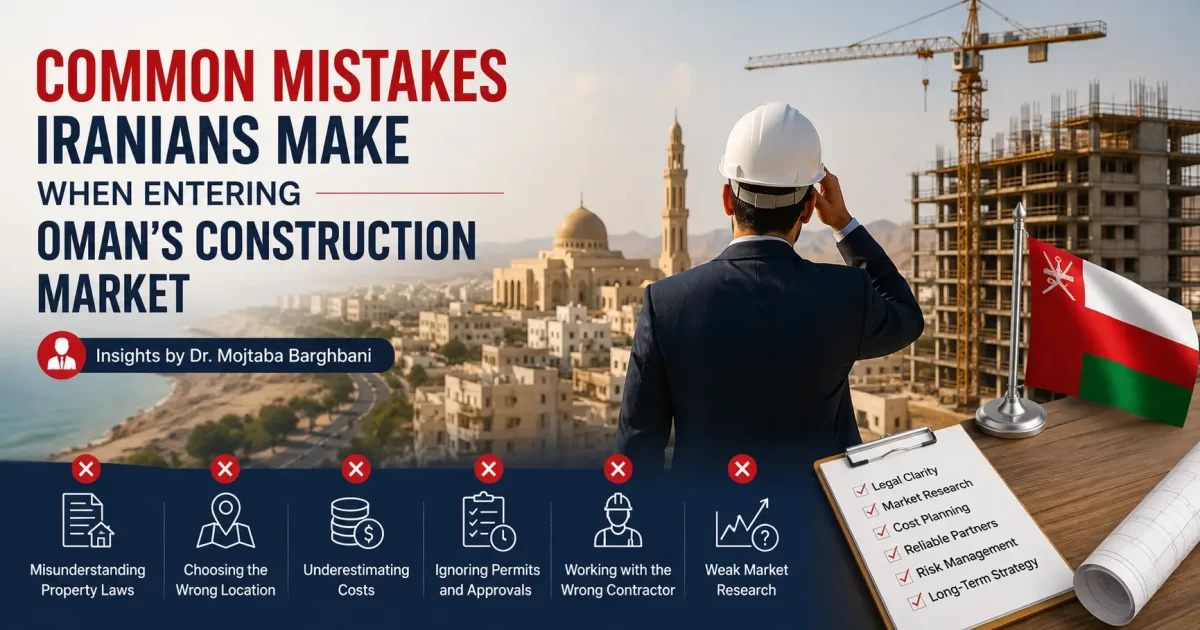
According to Dr. Mojtaba Barghbani, one of the most important challenges for Iranian investors is not lack of capital, but lack of structured market entry. A construction project in Oman needs legal review, feasibility analysis, local coordination, cost planning, contractor evaluation, and a clear exit strategy before any serious investment decision is made.
In this article, we review the most common mistakes Iranians make when entering Oman’s construction market and explain how these mistakes can be avoided.
Advantages and Disadvantages of Buying Land and Building Property in Oman
Why Oman’s Construction Market Attracts Iranian Investors
Before discussing the mistakes, it is important to understand why Oman is attractive in the first place. Oman is working toward economic diversification and long-term development. The country is investing in infrastructure, tourism, ports, industrial areas, residential projects, logistics, and new urban destinations. For construction investors, this creates a market with real potential.
Iranian investors are often interested in Oman because of several reasons:
Oman is geographically close to Iran. The country has a relatively stable business environment. There is demand for residential, hospitality, and mixed-use developments in selected areas. Oman is less saturated than some other Gulf markets. It can offer opportunities for long-term investors who understand the local system.
But this potential does not mean every project will be profitable. A profitable construction project in Oman depends on choosing the right location, understanding ownership rules, calculating realistic costs, using qualified local consultants, and designing a product that matches market demand.
Mistake 1: Entering the Market Without Local Feasibility Study
One of the biggest mistakes Iranian investors make is entering Oman based on general information, personal recommendations, or emotional excitement. Some investors hear that Oman is growing and immediately assume that any construction project will generate profit. This is risky.
A feasibility study is not just a document for banks or formal procedures. It is a practical tool that answers important questions:
Is the selected location suitable for the project?
Who is the target buyer or tenant?
What is the expected construction cost?
How long will the permit process take?
What are the risks of delay?
What is the expected selling or rental price?
How much working capital is needed until completion?
What is the exit strategy?
Without this analysis, investors may enter a project that looks attractive on paper but becomes difficult during execution. For example, a residential project may be located in an area where demand is weak. A commercial project may be planned in a location without enough foot traffic. A villa project may be designed with Iranian preferences, while the Omani market expects a different layout, climate response, parking solution, or privacy structure.
Dr. Mojtaba Barghbani emphasizes that feasibility in Oman must be local, not copied from another country. A project that works in Tehran, Shiraz, Dubai, or Istanbul may not work in Muscat, Salalah, Sohar, Nizwa, or Duqm.
Mistake 2: Misunderstanding Foreign Ownership Rules
Another common mistake is assuming that foreigners can buy and develop property anywhere in Oman without limitations. Foreign ownership in Oman has specific frameworks, and the rules differ depending on the type of property, project, location, and investment structure.
Some foreign investors can own property in designated developments such as Integrated Tourism Complexes, commonly known as ITCs. These projects are designed to allow foreign ownership under specific conditions. However, not every land or property in Oman is open for foreign ownership in the same way.
This is a critical point. Some investors enter negotiations before checking whether the property can legally be owned, developed, transferred, or used for the intended purpose. This can create legal complications, financial losses, or delays.
Before any payment or agreement, the investor should confirm:
The legal status of the land or property
Whether foreign ownership is allowed
Whether the land use matches the intended project
Whether development rights exist
Whether there are restrictions on resale or transfer
Whether the investment structure needs an Omani partner or local company
Whether the project qualifies for residency or other investor benefits
This step should be handled with the help of qualified legal and investment consultants in Oman. Relying only on verbal promises is a major mistake.
Mistake 3: Choosing a Location Based Only on Price
Many investors focus too much on land price. They think that buying cheaper land means higher profit. In construction, this is not always true. Cheap land can become expensive if the location is weak, infrastructure is incomplete, demand is limited, or approvals are difficult.
In Oman, location analysis should include more than the purchase price. Investors must check access roads, utilities, zoning, nearby developments, future government plans, demographic demand, tourism flow, distance from business centers, and resale potential.
For example, a land plot may look affordable, but if it is far from active demand centers, the project may take longer to sell. Another location may be more expensive, but it may offer stronger absorption, better rental demand, and more reliable exit options.
The correct question is not “Where is the cheapest land?” The correct question is “Where does the project have the best balance of cost, demand, legal clarity, infrastructure, and exit potential?”
Mistake 4: Underestimating Construction Costs in Oman
Some Iranian investors estimate construction costs based on their experience in Iran. This can lead to serious budgeting errors. Oman has different material costs, labor rules, contractor pricing, import conditions, climate requirements, technical standards, and project management expenses.
Construction costs in Oman may be affected by:
Material availability
Import costs
Labor regulations
Contractor qualification
Project location
Design complexity
Permit requirements
Climate-resistant specifications
Utility connections
Consultant and supervision fees
Currency and payment timing
Delays in approvals or supply chains
A common mistake is calculating only direct construction costs and ignoring soft costs. These may include engineering design, legal services, municipal approvals, supervision, project management, insurance, marketing, sales commissions, maintenance planning, and contingency budget.
A serious investor should always include a contingency reserve. Construction projects rarely move exactly according to the first estimate. Without a reserve, even a minor delay or material price change can damage the entire financial plan.
Mistake 5: Starting Before Understanding Permits and Approvals
Construction in Oman requires proper approvals, permits, design reviews, municipal coordination, and compliance with local regulations. Some investors assume that once they own the land, construction can begin quickly. This is not a safe assumption.
Permitting can involve multiple stages depending on the project type and location. A villa, apartment building, commercial property, hotel, warehouse, or mixed-use project may each require different documentation and approvals.
Before starting, investors should understand:
Which authority is responsible for approval
What documents are required
How long the approval process may take
Whether the design matches local requirements
Whether additional environmental or utility approvals are needed
Whether there are restrictions on height, density, setbacks, or land use
Whether the project requires special licenses
Ignoring this stage can lead to redesign costs, project delays, penalties, or even rejection of the planned development. A good consultant can identify approval risks before the investor commits significant capital.
Mistake 6: Working With the Wrong Contractor
Choosing the wrong contractor is one of the most expensive mistakes in any construction market. In Oman, this mistake can happen when investors select a contractor based only on price or personal introduction.
The cheapest contractor is not always the best choice. A low price may hide weak project management, poor technical capacity, cash flow problems, limited equipment, unqualified labor, or lack of experience with similar projects.
Before signing a contract, investors should review:
The contractor’s license and registration
Previous completed projects
Financial capacity
Technical team
Project schedule
Safety record
Quality control system
Material procurement ability
References from previous clients
Dispute history
Insurance and warranty terms
A professional contractor should provide a clear scope of work, payment schedule, timeline, specifications, and responsibilities. The contract should also include delay penalties, quality standards, variation rules, dispute resolution procedures, and handover conditions.
Dr. Mojtaba Barghbani advises investors to avoid informal agreements in construction projects. In Oman, as in any serious market, verbal promises cannot replace a professionally written contract.
Mistake 7: Ignoring Omani Business Culture
Oman has a unique business culture. It is generally calm, relationship-based, respectful, and process-oriented. Iranian investors who enter the market with aggressive negotiation tactics or unrealistic speed expectations may face difficulties.
Building trust matters in Oman. Local partners, consultants, authorities, contractors, and buyers value professional behavior, patience, clarity, and respect. Decisions may take time, but a stable and respectful relationship can create long-term value.
Common cultural mistakes include:
Pushing for decisions too quickly
Ignoring formal communication
Assuming all Gulf markets behave like Dubai
Not respecting local customs
Using unclear negotiation language
Failing to build local relationships
Underestimating the value of reputation
In Oman, reputation is a business asset. A developer who delivers quality, respects contracts, and communicates professionally can build strong trust over time.
Mistake 8: Designing the Project for Iranian Taste Instead of Omani Demand
A construction project must be designed for its target market. Some Iranian developers enter Oman and design villas, apartments, or commercial spaces based on Iranian lifestyle preferences. This can reduce market appeal.
Omani buyers and residents may have different expectations regarding privacy, family space, parking, guest areas, outdoor areas, heat control, natural ventilation, materials, façade style, and room distribution. Expat tenants may have different needs as well, especially in areas with international communities.
A successful design should answer these questions:
Who will buy or rent the property?
Is the project for Omanis, expatriates, tourists, or investors?
What size units are most in demand?
What amenities matter most?
How important is privacy?
How should the building respond to heat and sunlight?
What parking solution is expected?
What maintenance costs will the buyer face?
A beautiful design is not enough. The design must match the market.
Mistake 9: Forgetting Climate and Environmental Conditions
Oman’s climate affects construction decisions. Heat, humidity in coastal areas, dust, sunlight exposure, and occasional heavy rain in some regions can affect building performance. Materials, waterproofing, façade systems, insulation, HVAC design, shading, drainage, and maintenance planning must be selected carefully.
A material that works well in a mild climate may not perform well in Oman. A façade that looks attractive may create high cooling costs. Poor waterproofing can cause damage. Weak drainage can create problems during rain events. Insufficient insulation can make the building uncomfortable and expensive to operate.
Sustainable design is becoming more important in Oman. Projects that reduce energy consumption, improve comfort, and lower long-term maintenance costs can become more attractive to buyers and tenants.
Mistake 10: Not Planning for Sales and Marketing From the Beginning
Some investors think marketing starts after construction is completed. This is a mistake. In a professional construction project, sales strategy should begin before design finalization.
Marketing affects:
Project concept
Unit sizes
Pricing strategy
Brand positioning
Target audience
Payment plans
Showroom strategy
Digital presence
Sales materials
Investor communication
Handover experience
If the project is intended for foreign buyers, marketing should be multilingual and trust-based. If the project is for local buyers, the message should match local expectations. If the project targets rental income, the investor must understand tenant demand before construction starts.
A strong project is not only built well; it is positioned well.
Mistake 11: Having No Clear Exit Strategy
Every construction investment needs an exit strategy. Some investors enter the market with a general hope that prices will rise. This is not enough.
The exit strategy should be clear from the beginning. Will the investor sell units during construction? Sell after completion? Keep the property for rental income? Partner with a hotel operator? Sell to institutional investors? Transfer the project to another developer? Use the property for residency or business expansion?
Each strategy requires different planning. A project designed for sale may differ from a project designed for long-term rental. A tourism project may require different operational planning than a residential project. A commercial project may need anchor tenants before completion.
Without an exit strategy, the investor may complete the building but struggle to convert it into profit.
Mistake 12: Entering Without Professional Legal and Tax Advice
Construction investment involves contracts, ownership structures, company formation, taxation, employment rules, bank accounts, insurance, and dispute resolution. Trying to manage all of this without professional advice can be dangerous.
Investors should work with qualified legal, accounting, and business advisors before signing agreements. This is especially important for foreign investors who may not understand local regulations in detail.
Professional advice is needed for:
Company formation
Shareholder agreements
Land acquisition
Construction contracts
Employment arrangements
Tax obligations
Banking procedures
Residency-related investment routes
Dispute resolution
Profit repatriation
Asset protection
Good advice may seem like an extra cost at the beginning, but it can prevent much larger losses later.
Mistake 13: Overtrusting Informal Brokers
In many foreign markets, informal brokers play an active role. Some can be helpful, but relying only on brokers without verification is risky. Investors may receive exaggerated claims about land value, permit speed, rental demand, resale price, or government support.
Any claim should be verified through official documents, legal review, and independent market analysis. Investors should avoid making payments based on pressure, urgency, or promises that are not written into legal agreements.
A professional advisor will not push the investor to decide blindly. A professional advisor will help the investor understand risks, compare options, and make a structured decision.
Mistake 14: Ignoring Project Management
A construction project in Oman cannot be managed remotely with occasional visits. Some Iranian investors assume they can control the project from Iran through phone calls and messages. This often leads to delays, cost overruns, and quality issues.
Project management is essential. The investor needs someone on the ground to monitor progress, review contractor performance, check quality, control payments, manage documentation, and report problems early.
Good project management includes:
Regular site inspections
Progress reports
Budget tracking
Schedule control
Quality checks
Variation management
Contractor coordination
Risk reporting
Payment verification
Handover documentation
Without project management, the investor may discover problems too late.
Mistake 15: Expecting Fast Profit Without Long-Term Strategy
Oman is not a market for impatient investors. It can offer strong opportunities, but it often rewards long-term thinking, structured planning, and professional execution. Investors who expect very fast profit may become disappointed or make poor decisions.
The best approach is to treat Oman as a strategic market. This means studying the market, entering with a clear plan, starting with manageable project size, building local relationships, and expanding gradually.
Dr. Mojtaba Barghbani believes that Iranian investors can succeed in Oman if they move from emotional investment to professional investment. Capital alone is not enough. The difference between success and failure is usually planning, legal clarity, local execution, and market understanding.
How to Choose a Reliable Contractor in Oman: A Complete Guide for Investors and Homeowners
How Iranian Investors Can Enter Oman’s Construction Market Correctly
To avoid the mistakes above, Iranian investors should follow a structured process.
First, define the investment objective. Is the goal profit from development, rental income, residency, company expansion, or long-term asset holding?
Second, conduct market research. Compare locations, project types, buyer demand, rental demand, construction costs, and competitor projects.
Third, review legal ownership and business structure. Confirm whether the land or property can be owned or developed by a foreign investor.
Fourth, prepare a financial model. Include land cost, construction cost, soft costs, financing, taxes, marketing, contingency, and expected revenue.
Fifth, select qualified local consultants. This may include legal advisors, engineering consultants, project managers, contractors, and sales advisors.
Sixth, create a risk management plan. Identify risks related to permits, costs, delays, contractors, demand, currency, and legal issues.
Seventh, manage execution professionally. Use written contracts, regular reports, quality control, and clear payment milestones.
This process may take more time at the beginning, but it protects the investor and increases the chance of success.
The Role of Dr. Mojtaba Barghbani in Guiding Investors
For Iranian investors, entering a foreign construction market can be challenging because they need to understand both the investment opportunity and the local execution environment. Dr. Mojtaba Barghbani can play an important role in helping investors approach Oman’s construction market with a more strategic mindset.
His approach focuses on avoiding emotional decisions, reviewing the legal and financial structure, analyzing the project before capital is committed, and helping investors understand the real risks of construction in Oman. This type of guidance is especially valuable for investors who are entering the Omani market for the first time.
Instead of asking only “How much profit can this project make?”, investors should ask “What must be checked before this project becomes safe, legal, executable, and profitable?” This shift in thinking can prevent many common mistakes.
Conclusion
Oman’s construction market offers real opportunities for Iranian investors, but it is not a market that should be entered without preparation. The biggest mistakes usually happen when investors rely on assumptions, ignore legal rules, underestimate costs, choose the wrong location, trust informal brokers, or manage projects without local expertise.
A successful construction investment in Oman requires feasibility study, legal review, market research, financial planning, professional contracts, qualified contractors, and strong project management. It also requires respect for Omani business culture and a long-term view of the market.
Iranian investors who approach Oman with patience, structure, and expert guidance can reduce risk and position themselves for sustainable growth. With the support of experienced advisors such as Dr. Mojtaba Barghbani, the path to entering Oman’s construction market can become clearer, safer, and more professional.
Frequently Asked Questions
1. Is Oman a good market for Iranian construction investors?
Yes, Oman can be a good market for Iranian construction investors, especially for those who enter with proper research, legal guidance, and realistic financial planning. The country has long-term development goals and opportunities in real estate, tourism, infrastructure, and urban development. However, success depends on choosing the right project and avoiding emotional investment decisions.
2. Can foreigners buy property in Oman?
Foreigners can own property in Oman under specific legal frameworks, especially in designated projects such as Integrated Tourism Complexes. However, ownership rules are not the same for every property or location. Investors should always confirm the legal status of the property before making any payment.
3. What is the biggest mistake Iranian investors make in Oman?
The biggest mistake is entering the market without a local feasibility study. Many investors rely on general information or personal recommendations, while every construction project needs detailed analysis of location, cost, permits, demand, legal structure, and exit strategy.
4. Do Iranian investors need an Omani partner for construction projects?
It depends on the project type, business structure, legal requirements, and investment activity. Some sectors may allow foreign ownership, while others may require specific structures or local arrangements. A legal advisor in Oman should review the case before registration or investment.
5. Is construction in Oman cheaper than Dubai?
In many cases, Oman may have more competitive costs than Dubai, but this does not mean every project is cheaper or more profitable. Costs depend on location, design, materials, contractor selection, permits, and project complexity. Investors should compare total project cost, not only land or labor cost.
6. Which cities in Oman are attractive for construction investment?
Muscat, Salalah, Sohar, Nizwa, Duqm, and selected tourism or industrial areas may offer opportunities depending on the project type. The best city depends on whether the investor wants residential development, tourism projects, commercial buildings, logistics facilities, or long-term rental income.
7. How important is project management in Oman?
Project management is very important. A construction project should not be managed remotely without local supervision. Regular site inspections, quality checks, contractor coordination, payment control, and progress reporting are necessary to reduce risk.
8. What should investors check before buying land in Oman?
Investors should check ownership rights, land use, zoning, access roads, utilities, development permissions, foreign ownership eligibility, future area plans, and resale potential. Legal review is essential before signing any agreement.
9. Can construction investment in Oman lead to residency?
Oman has investment-based residency routes, and some real estate investments in eligible projects may qualify under specific conditions. However, investors should verify the latest requirements before making a decision, because residency rules can change.
10. How can Dr. Mojtaba Barghbani help investors entering Oman?
Dr. Mojtaba Barghbani can help investors approach the Omani construction market with a structured strategy. This includes reviewing investment goals, identifying risks, emphasizing feasibility analysis, and guiding investors toward professional decision-making before capital is committed.



No comment